

· By Kelin Marquet
The Liposome: Revolutionary Vitamin Technology or Marketing Gimmick?
“Liposomal” vitamin delivery has become one of the most talked-about trends in the supplement industry. If you have searched for vitamin C, multivitamins, or liquid supplements recently, chances are you have seen products promoting liposomal technology.
But is there solid science behind the claims?
This article explains what liposomes are, what current research says about them, the limitations of liposomal delivery systems, and why Why Not Natural has chosen not to release liposomal supplements at this time.
What Is a Liposome?
Scientifically speaking, a liposome is a tiny artificial sphere made from phospholipids. Phospholipids are fat-like compounds that contain a phosphate group and are similar to the structure of human cell membranes.
These microscopic spheres are designed to encapsulate nutrients or pharmaceutical compounds. Because they resemble human cell membranes, liposomes may help transport ingredients more efficiently through the digestive system.
The phospholipids used in liposomal supplements are commonly derived from soy lecithin or sunflower lecithin.
In simpler terms, liposomes are tiny fat-like bubbles created to carry nutrients and potentially improve how they are delivered in the body.
Liposomes have been studied since their discovery in 1964 and have been used in pharmaceutical applications, including drug delivery systems for certain medical treatments. (1)

What Are the Potential Benefits of Liposomal Delivery?
Liposomal Vitamin C
Vitamin C is one of the most common nutrients used in liposomal supplements because it is water-soluble and may benefit from enhanced absorption in the digestive tract.
The body absorbs vitamin C in limited amounts at one time. Once intake exceeds certain levels, the excess is typically excreted.
For most people, this is not a concern. The recommended daily intake of vitamin C is:
- 75 mg per day for women
- 90 mg per day for men
- 120 mg per day during pregnancy and breastfeeding
Research suggests that higher intakes of vitamin C are generally tolerated, although large amounts may contribute to digestive discomfort in some individuals.
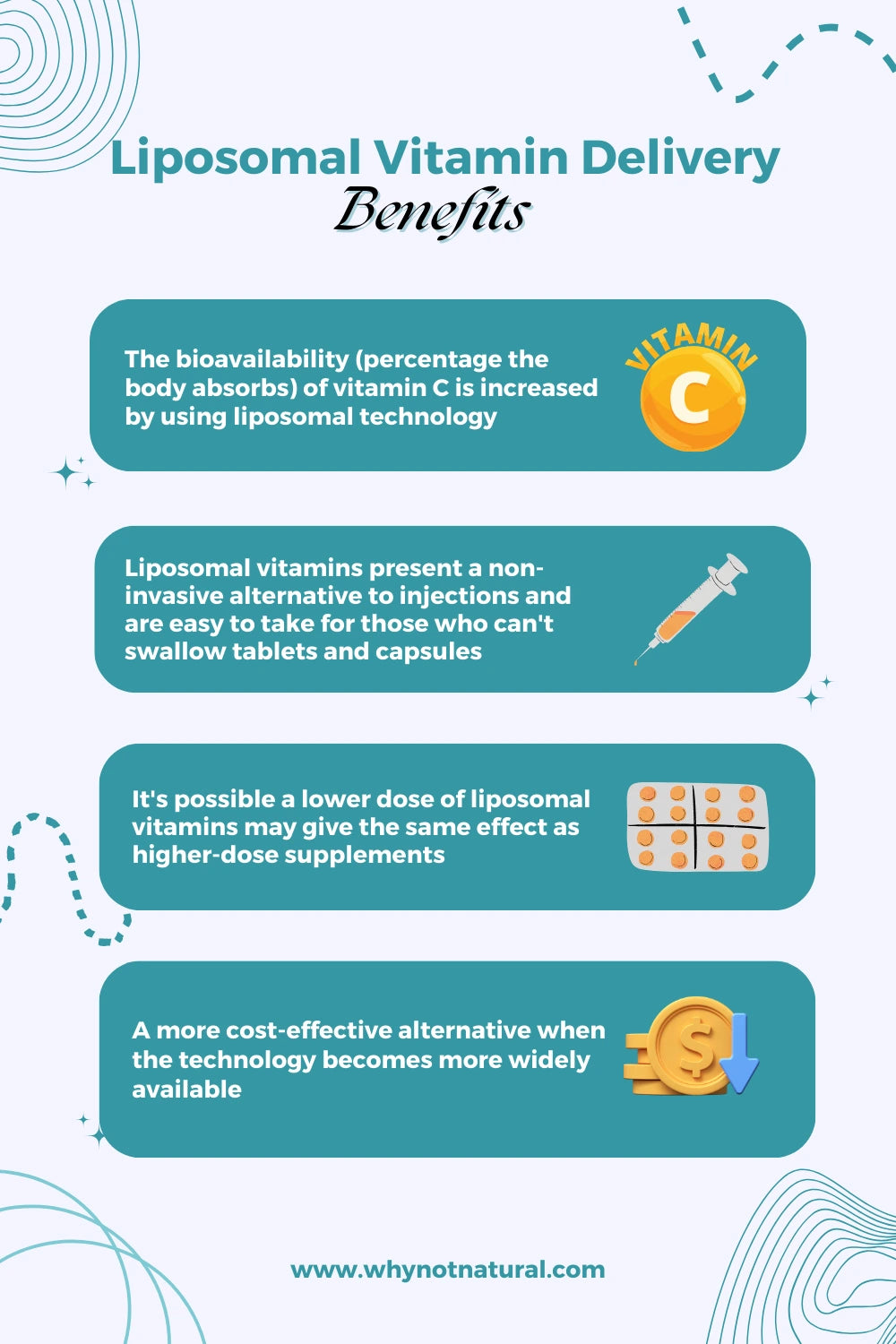
Some studies suggest liposomal vitamin C may increase vitamin C bioavailability compared to standard oral forms. However, absorption can also be supported by dividing servings throughout the day or choosing buffered forms that are gentler on digestion.

Liposomal Delivery for Other Vitamins
Because liposomal technology may improve absorption for vitamin C, some manufacturers suggest similar benefits for other nutrients.
However, research on liposomal delivery for most vitamins and minerals remains limited.
Liposomal supplements are often marketed as a convenient alternative to injections and may appeal to people who prefer liquid supplements over capsules or tablets.
It has also been proposed that smaller amounts of liposomal nutrients could potentially provide comparable effects to larger amounts of conventional supplements. More research is needed to confirm these claims.
What Does the Research Say About Liposomal Vitamins?
One randomized trial evaluated the stability and particle size of liposomal vitamin C and found it to be approximately 1.77 times more bioavailable than non-encapsulated vitamin C. (2)
Another study compared intravenous vitamin C, liposomal vitamin C, and standard oral vitamin C supplements. Researchers found that liposomal vitamin C resulted in higher blood vitamin C levels than standard oral vitamin C, although intravenous administration remained significantly more effective. (3)
It is important to note that the study used a 4-gram serving of vitamin C, which is substantially higher than the daily recommended intake.
At this time, most available research on liposomal supplements focuses on vitamin C. Evidence for other liposomal vitamins remains limited.

What Are the Challenges With Liposomal Vitamins?
Verifying Liposomal Claims
One of the biggest concerns surrounding liposomal supplements is verifying whether a product truly contains stable, properly formed liposomes.
Producing authentic liposomal technology requires sophisticated manufacturing methods and can be expensive. Currently, there is no universal requirement for supplement manufacturers to independently verify liposomal structure or stability on finished products.

“Pseudo-Liposomal” Products
Some manufacturers use lower-cost techniques that may create mixtures resembling liposomes rather than true liposomal particles.
For example, some production methods create gels or milky emulsions with inconsistent particle sizes. Because liposomal effectiveness depends heavily on particle uniformity and stability, inconsistent structures may not provide the intended benefits.
Liposome Stability
Another challenge is stability during manufacturing, transportation, and storage.
Liposomes can be sensitive to oxidation and hydrolysis, processes that may degrade the phospholipid structure over time. (4)
As a result, the stability of a liposomal supplement may depend heavily on ingredient quality, manufacturing standards, packaging, and storage conditions.
Unfortunately, consumers typically have no practical way to confirm whether a product still maintains stable liposomal structures by the time it is purchased. (5)
Should You Take a Liposomal Supplement?
Liposomal supplements are often significantly more expensive than traditional supplement forms. Whether they are worth the additional cost depends on several factors.
First, while liposomal technology has been used in pharmaceutical settings for decades, its use in dietary supplements is relatively new. Manufacturing true liposomal products requires advanced technology that may not be used consistently across the supplement industry.
Second, consumers generally have limited ways to verify whether a product marketed as liposomal contains stable and effective liposomes.
Finally, the nutrient form itself remains extremely important.
For example, a high-quality nutrient form may still be preferable to a lower-quality form delivered through liposomal technology. Choosing bioavailable forms of nutrients can play an important role in overall supplement quality.
As one example, many people prefer methylcobalamin vitamin B12 over cyanocobalamin because methylcobalamin is an active form that the body can readily use.

Liquid vitamins offer many of the same benefits of liposomes: liquid form so it's easy to take, the ability to choose your dose, and enhanced absorption.
A Practical Alternative
Liquid vitamins can offer several practical advantages similar to those promoted by liposomal products.
They are easy to take, allow flexible serving sizes, and may support absorption compared to some conventional tablets.
In addition, finished liquid supplements can be independently tested for identity, purity, and potency. Why Not Natural tests its products before release to help support quality and transparency.
If you are exploring liquid vitamin options, Why Not Natural offers a variety of liquid supplements designed to support everyday wellness needs.
Stay Connected
Want to learn more about supplements, wellness strategies, and nutrition tips? Subscribe to our newsletter for educational content, product updates, and practical guidance to support your health journey.
https://whynotnatural.com/pages/holistic-health-journey
Disclaimer
The statements in this article have not been evaluated by the Food and Drug Administration. The products mentioned are not intended to diagnose, treat, cure, or prevent any disease. Please check with a doctor before starting any new supplement and to ensure the advice in this article is right for you.
Resources
(1) Application of liposomes in medicine and drug delivery
Hadis Daraee, Ali Etemadi, Mohammad Kouhi, Samira Alimirzalu & Abolfazl Akbarzadeh
https://www.tandfonline.com/doi/full/10.3109/21691401.2014.953633
(2) Evaluation and clinical comparison studies on liposomal and non-liposomal ascorbic acid (vitamin C) and their enhanced bioavailability
https://pubmed.ncbi.nlm.nih.gov/32901526/
(3) Liposomal-encapsulated Ascorbic Acid: Influence on Vitamin C Bioavailability and Capacity to Protect Against Ischemia–Reperfusion Injury
https://www.ncbi.nlm.nih.gov/pmc/articles/PMC4915787/
(4) Liposomes: Structure, Biomedical Applications, and Stability Parameters With Emphasis on Cholesterol
https://www.frontiersin.org/articles/10.3389/fbioe.2021.705886
(5) Loss of Plasma Membrane Phospholipid Asymmetry Requires Raft Integrity
Corinne Kunzelmann-Marche, Jean-Marie Freyssinet, M. Carmen Martı́nez
https://www.jbc.org/article/S0021-9258(20)85057-1/fulltext